Mason & Ichneumon Wasps: New Zealand's Helpful, Harmless Wasps
Big long-tailed wasp? Tiny mud-builder? They're probably mason and ichneumon wasps — NZ's beneficial, non-stinging wasps. Here's how to tell them from the real pests.
Not every wasp-shaped insect in your garden is a pest. New Zealand has a suite of solitary, non-aggressive "wasps" that look alarming but are either harmless or genuinely helpful — the mason wasp and the ichneumon wasps among them. Knowing the difference stops you from panicking over a garden ally, and keeps your attention (and your traps) on the wasps that actually matter.
The NZ mason wasp (sometimes called the mason bee)
The New Zealand mason wasp builds tiny nests of mud — clusters of little earthen cells or tubes — stuck to walls, under eaves, in window corners or inside hollow stems. It's solitary: each female builds her own small nest, stocks it with paralysed prey (often spiders or caterpillars) for her larvae, seals it, and moves on. There's no colony, no queen, and no defensive swarm.
Appearance: small, dark, often black with a narrow waist; you'll usually see it carrying a tiny ball of mud. Some have a metallic blue-black sheen.
Do they sting? Essentially no. Mason wasps are non-aggressive and their sting (if they even have one capable of penetrating skin) is not used in defence. They're safe around children and pets.
Should you remove them? Only if the mud nests are somewhere genuinely inconvenient (right in a window mechanism, say). They're beneficial — they control spiders and caterpillars — and they pollinate as they go. If they're on a quiet wall, leave them be.
Ichneumon wasps
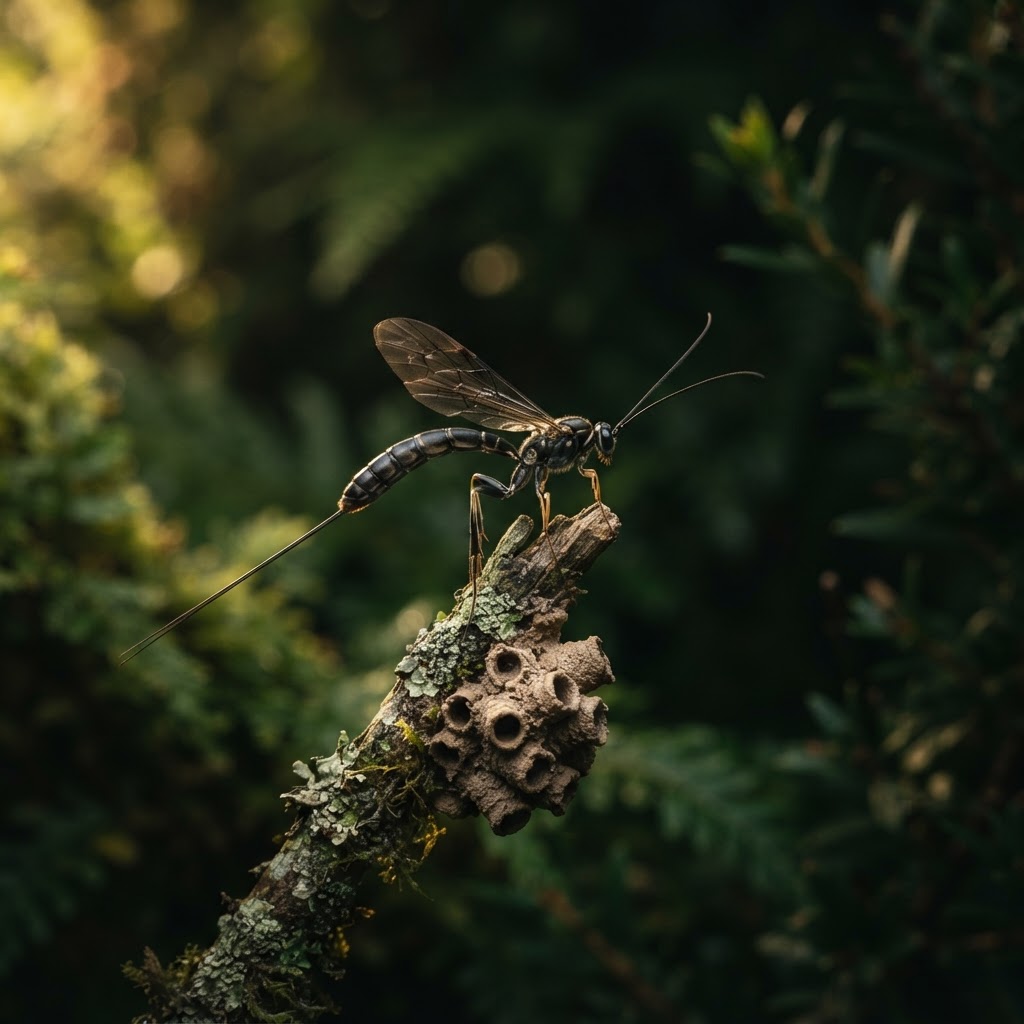
Ichneumon wasps are a large family of parasitoid wasps — and some of them look genuinely unsettling. They're often long-bodied, with very long antennae and, in several species, a strikingly long ovipositor that looks like a fearsome stinger. People frequently panic at the sight of one.
But ichneumon wasps are parasitoids of other insects — they lay eggs in or on caterpillars, grubs, pupae and other insect larvae. The vast majority cannot sting humans; that long "stinger" is an egg-laying tube, and in most species it's physically incapable of penetrating human skin. They are among the most useful insects in the garden, quietly suppressing pest caterpillars and wood-boring grubs.
What to do: nothing. Watch, marvel, and let them work. They're a sign of a healthy, balanced garden. If one's indoors, catch-and-release the same way you would any stray insect.
How to tell the good wasps from the problem wasps
- Solitary & quiet, building tiny mud nests: mason wasp — beneficial, leave alone.
- Long-bodied with a long "stinger" and long antennae, alone: ichneumon wasp — beneficial, leave alone.
- Stocky yellow-and-black, fast, in numbers, after your drink: German or common wasp — see our control guide.
- Slender, long-legged, small open grey comb under eaves: paper wasp — see our paper wasp guide.
Why it matters to get this right
Sweet-bait wasp traps are built for the social wasps — German, common and (less so) paper wasps — that forage for sugar and meat. Mason and ichneumon wasps don't go for those baits, won't be caught, and shouldn't be. Misidentifying a beneficial wasp as a pest leads to needless insecticide use and fewer of the very insects helping your garden. When in doubt, send a photo to Buzzy for a confident ID.
Encouraging beneficial wasps
- Leave some hollow stems and dead wood in a corner of the garden for solitary nesters.
- A south- or east-facing mud bank or bare soil helps mason wasps gather building material.
- Minimise broad-spectrum insecticide — it hits the good wasps harder than the pests.
- Plant a diversity of flowering natives and herbs; adult parasitoids feed on nectar.
Not sure which wasp is which?
Snap a photo and Buzzy will tell you friend from foe — and whether you need a trap at all.
Ask Buzzy 🐝 All wasp guides
Not sure which pest you're dealing with?
Snap a photo and — our NZ-made AI pest assistant will identify it from our verified species database and recommend the right trap. Free, honest, and grounded in real Kiwi catch data.
GotchaPest Team
NZ-made pest control, designed in Aotearoa for Kiwi conditions. Our traps are UV-tough, reusable and bee-safe — paired with the world's first AI Trap Buddy and the GotchaPest community pest tracker. Available at Mitre 10, Kings Plant Barn and right here online.
Trap smarter with GotchaPest
UV-tough, NZ-made traps paired with the app and Buzzy — the first ever AI Trap Buddy.